Last updated 4/8/26
What Are Your ADU Options? How Haven’s Free Feasibility Tool Evaluates Your Property
The challenge is figuring out which ones actually work for your specific lot. It depends on your zoning district, your lot dimensions, what structures already exist on your property, flood zone status, and a dozen other factors that interact in ways that aren’t obvious from a Google Maps screenshot.
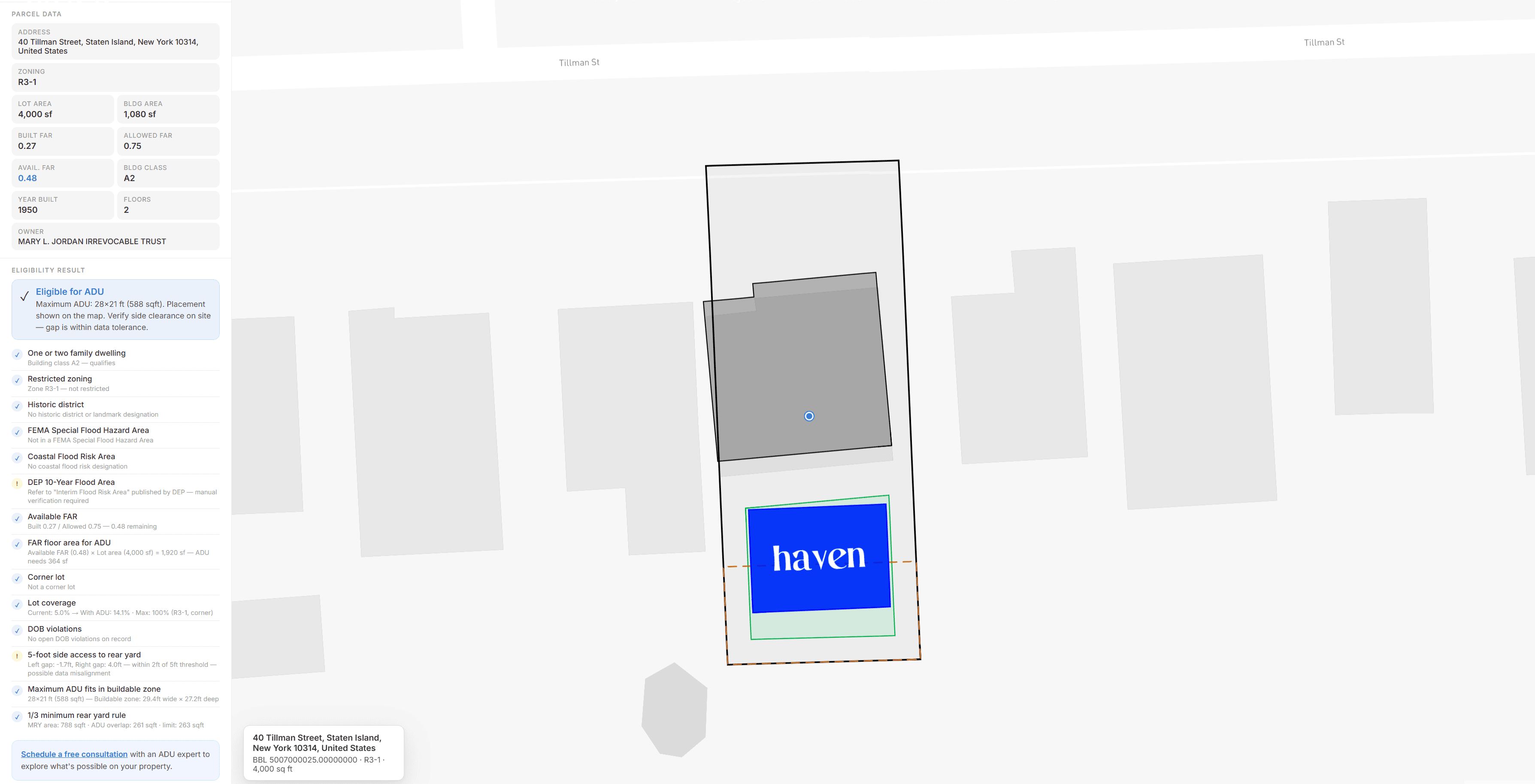
That’s what Haven’s free ADU feasibility tool is built to answer. Enter your address and it pulls data from six public NYC databases, runs over 30 individual checks, and generates a personalized report showing exactly which ADU types are feasible for your property, with maximum sizes and site plans for each. In this post, we’ll walk through how the tool works and what each part of the report means.
How the Tool Works
Haven’s feasibility tool evaluates your property for four distinct ADU types, each with its own set of eligibility checks, a custom site plan, and a maximum size calculation. Instead of a single pass/fail answer, you get a ranked menu of options.
The tool currently evaluates four structural ADU types: garage conversion, garage demo and rebuild, attached addition, and detached backyard unit. It does not cover basement or attic conversions, as Haven focuses exclusively on structural ADU projects.
Many homeowners assume that if they can’t build a detached backyard ADU, they have no options at all. That’s rarely the case. A property that doesn’t qualify for a standalone unit might be a great candidate for a garage conversion, a garage demo and rebuild, or an attached addition. The tool checks for all of these so you can see the full picture.
What You Get: The Feasibility Report
Enter your address and Haven generates a multi-page ADU Feasibility Assessment. Here’s what’s inside:
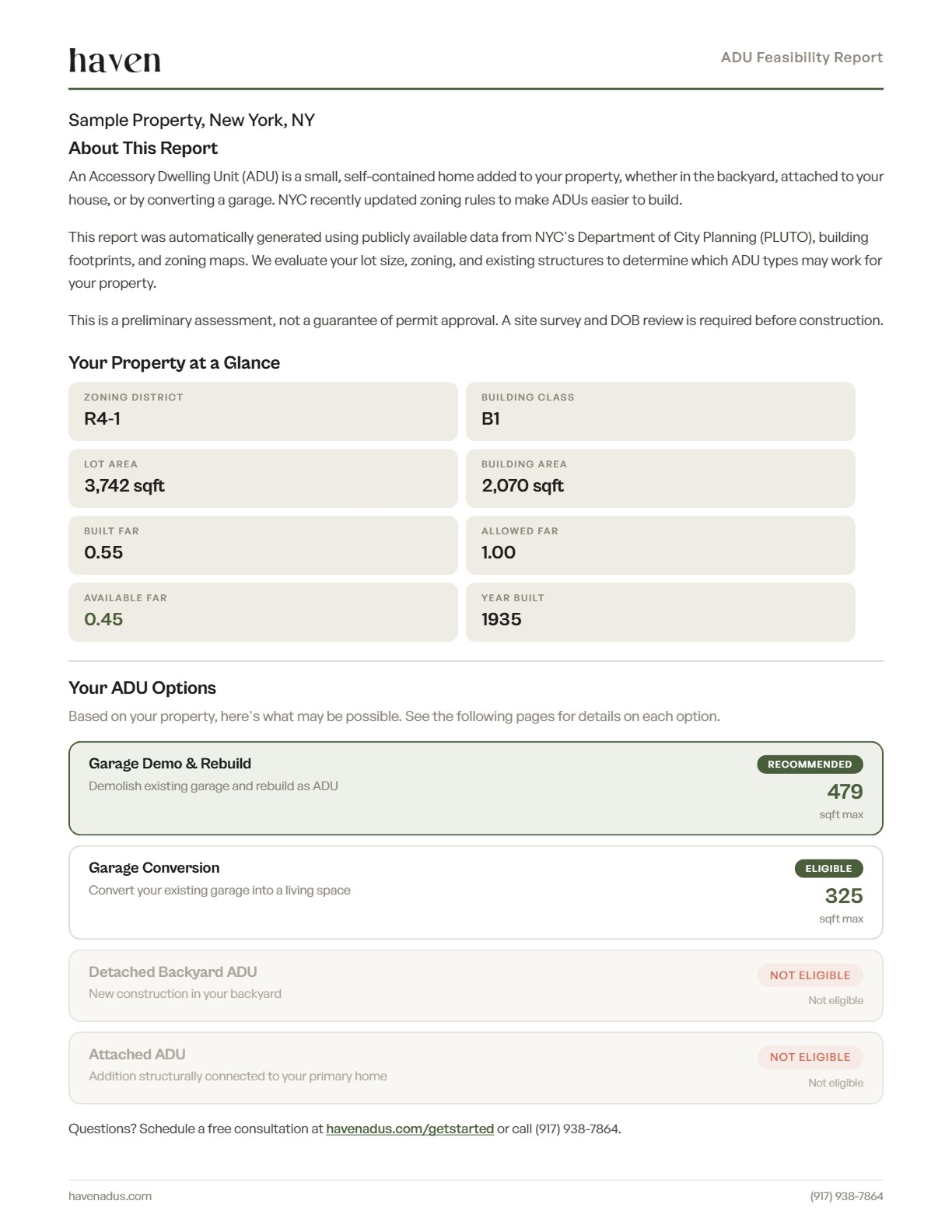
Property at a Glance. Your zoning district, building class, lot area, building area, built FAR, allowed FAR, available FAR, and year built, pulled directly from NYC’s Department of City Planning (PLUTO) and Department of Finance databases.
Your ADU Options. A summary showing which of the four structural ADU types are eligible for your property. Each option is labeled Recommended, Eligible, or Not Eligible, with the maximum square footage displayed. (The tool does not evaluate basement or attic conversions.)
Per-option detail pages. For each ADU type, you get a description of what’s involved, a color-coded site plan showing where the ADU could go on your lot, and a full checklist of every criterion we evaluated, with the specific data behind each check.
Our Running Example: A Single-Family Home in the Bronx
To show how the tool works, we’ll walk through the report for a sample property in the Bronx. It’s a single-family home (building class B1) on a 3,742 sqft lot in an R4-1 zoning district. The home was built in 1935, has a 2,070 sqft building area, and a built FAR of 0.55 against an allowed FAR of 1.00, leaving 0.45 FAR available for an ADU.
Here’s what the tool found
Garage Demo & Rebuild: Recommended, up to 479 sqft
Garage Conversion: Eligible, 325 sqft
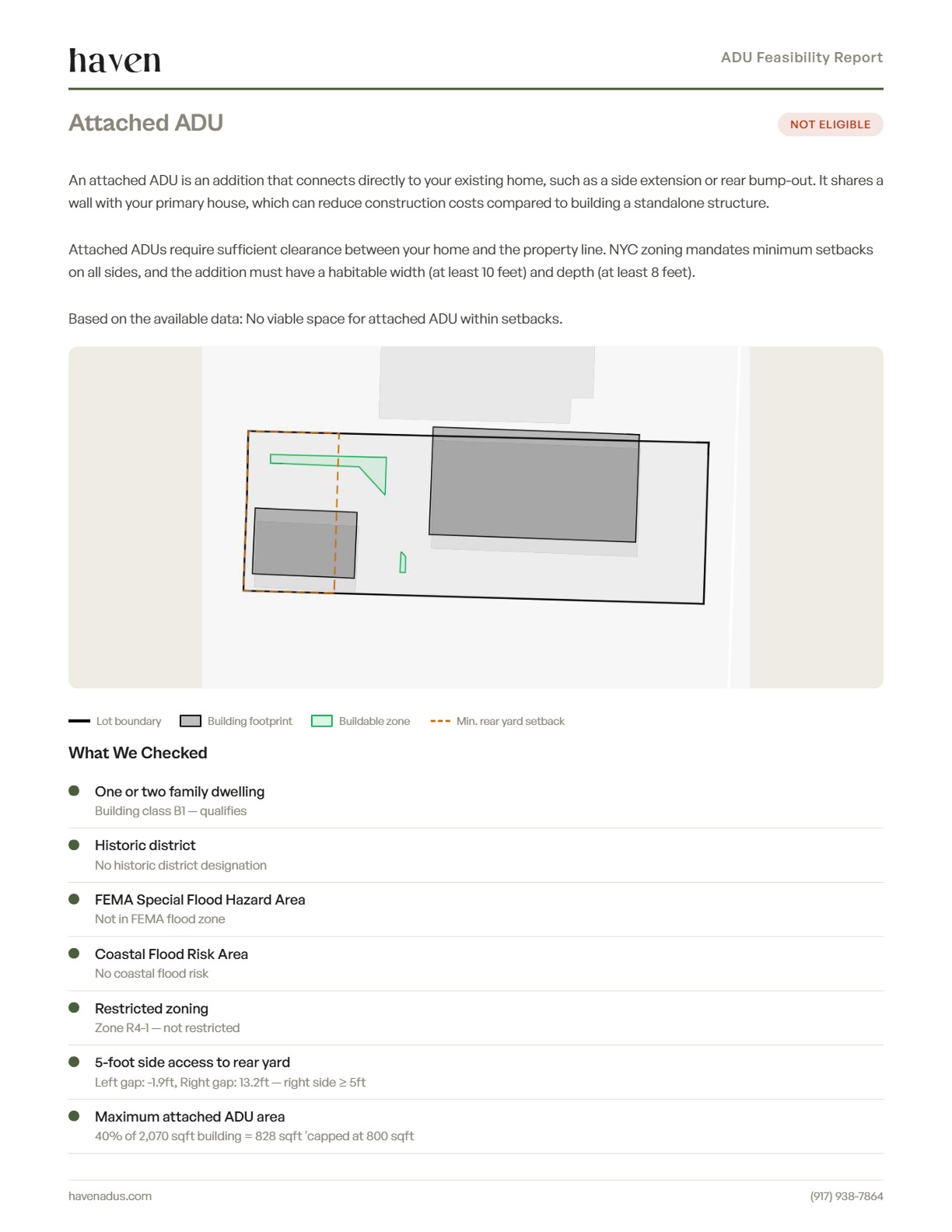
Attached ADU: Eligible, up to 269 sqft
Detached Backyard ADU: Not Eligible
This homeowner has three viable paths, including one we recommend. Let’s look at each option in detail.
Option 1: Garage Demo & Rebuild
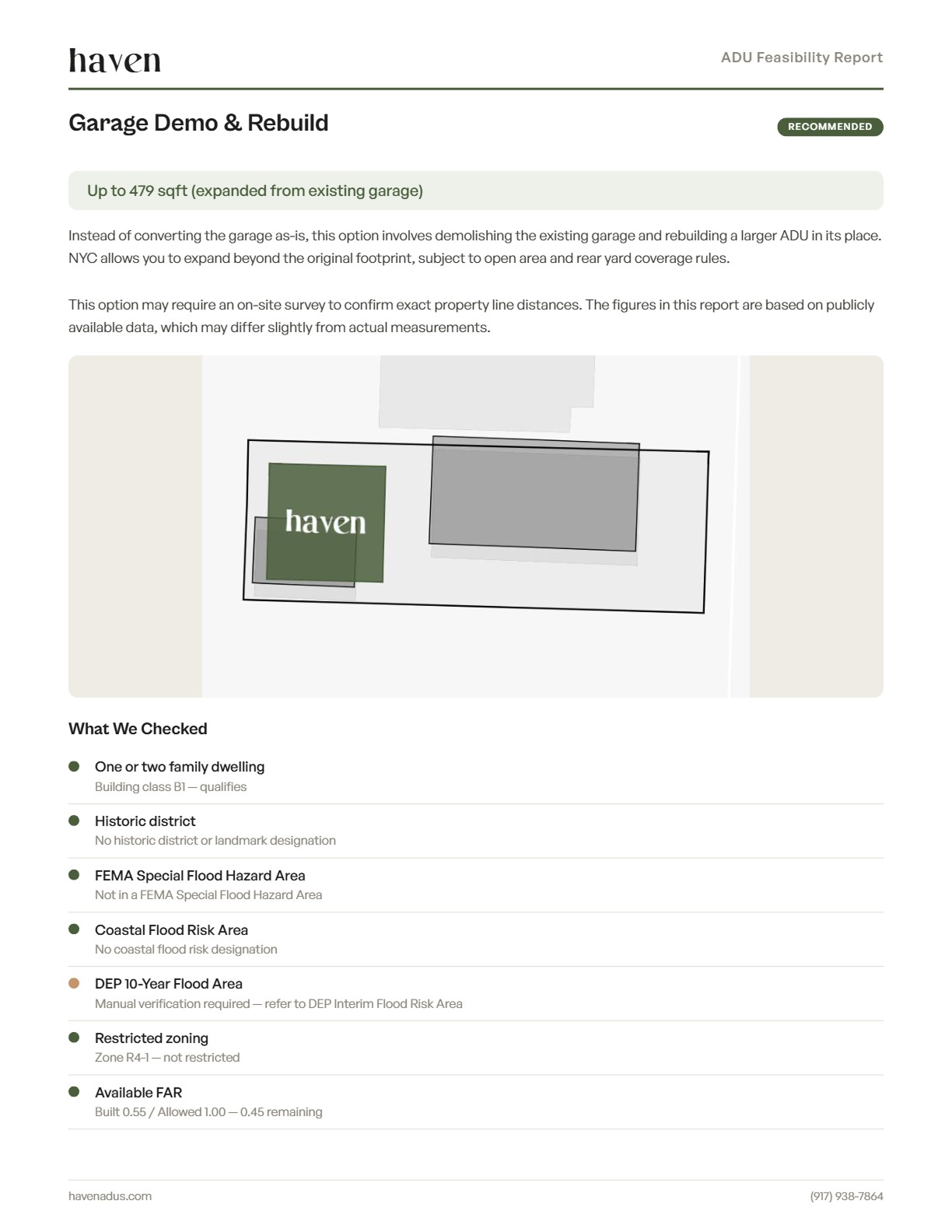
This option involves demolishing an existing garage and building a new, larger ADU in its place. Because NYC allows you to expand beyond the original garage footprint, subject to open area and rear yard coverage rules, this often yields the largest ADU of any option.
For our Bronx property, the tool identified a 325 sqft garage footprint and calculated that demolishing and rebuilding could yield an ADU of up to 479 sqft. That’s why it was marked as the recommended option.
What the tool checks for this option
Threshold checks (same as all options): building classification (must be a one- or two-family home), FEMA Special Flood Hazard Area, Coastal Flood Risk Area, DEP 10-Year Flood Area, and DOB open violations.
Garage detected: The tool analyzes building footprint data, using height, size, and position on the lot to identify existing garages. Each detection is scored and assigned a confidence level (high, medium, or low). In this case: 325 sqft, flagged as low confidence, meaning an on-site survey should confirm.
Historic district: Unlike detached ADUs, garage-based options in historic districts receive a warning rather than a hard fail, since they aren’t classified as a "Backyard ADU" under the Zoning Resolution.
Available FAR: Because a rebuild adds new floor area, the tool checks whether there’s enough remaining FAR capacity. It compares your built FAR against the allowed residential FAR for your zoning district.
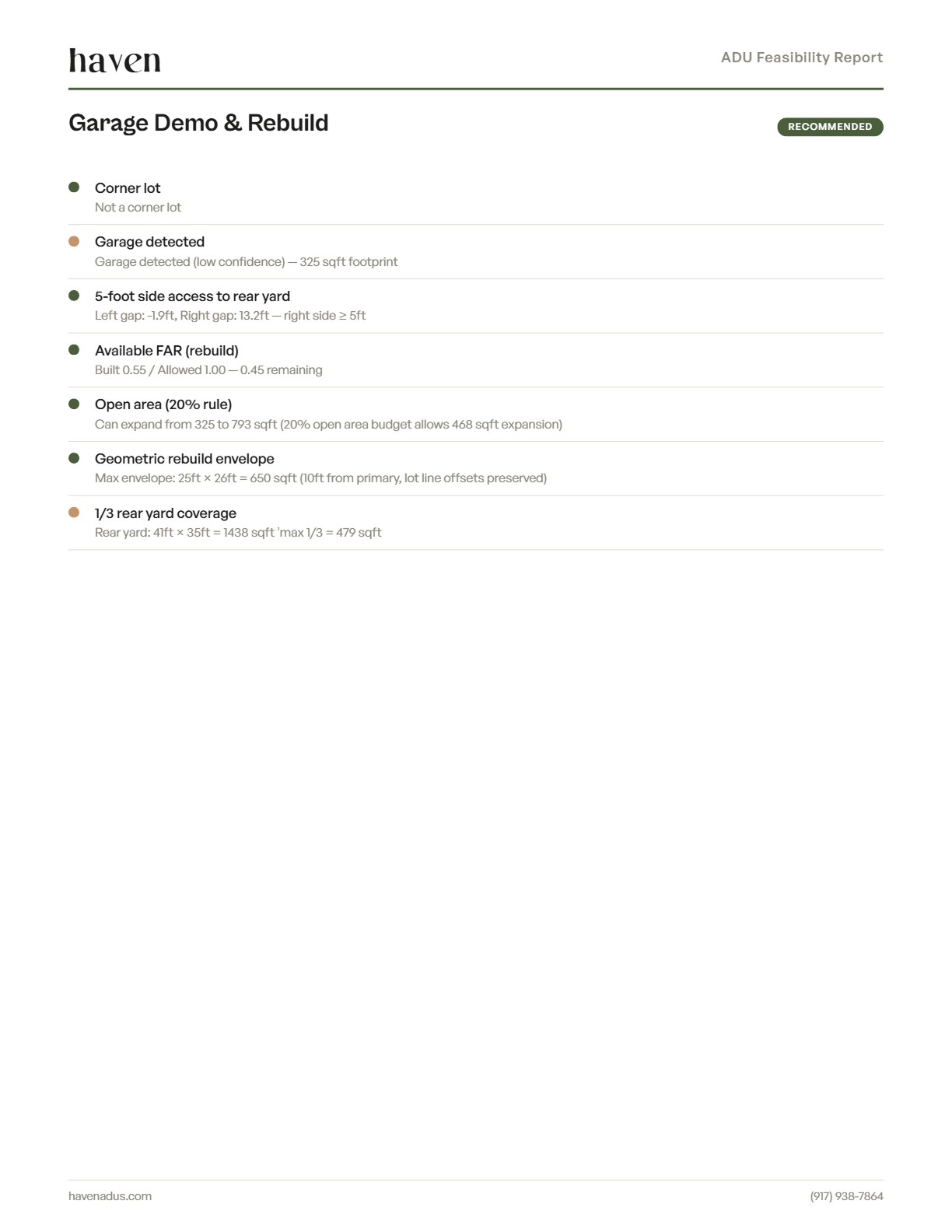
Corner lot: Unlike detached ADUs (which are not permitted on corner lots), garage-based options are allowed. Corner lots are flagged for context but don’t disqualify the project.
5-foot side access to rear yard: Is there at least 5 feet of clearance on one side of the house to reach the backyard? The tool measures both sides. For this property: left gap is 1.9 ft (not enough), right gap is 13.2 ft (qualifies).
Open area (20% rule): NYC requires that at least 20% of the lot remain as open area. The tool calculates how much the garage footprint can expand within this budget. Here: the original 325 sqft garage could expand to a 793 sqft open area budget, allowing up to 468 sqft of expansion.
Geometric rebuild envelope: What’s the maximum physical footprint that fits in the available space? The tool calculates a rebuild envelope based on lot line offsets and distance from the primary home (minimum 10 feet of clearance, at least 5 feet from any lot line). For this property: 25 ft × 26 ft = 650 sqft maximum envelope.
1/3 rear yard coverage: The ADU cannot cover more than one-third of the rear yard. The tool calculates: rear yard area (41 ft × 35 ft = 1,438 sqft), max one-third = 479 sqft. This is what caps the final size.
Final size: The maximum rebuild area is the smallest of: 800 sqft (absolute cap), the geometric envelope, the 20% open area budget, and the 1/3 rear yard limit. In this case, the rear yard rule is the binding constraint at 479 sqft.
Option 2: Garage Conversion
A garage conversion turns your existing garage into a livable ADU without changing the building’s footprint. You’re renovating the interior to meet residential building codes: adding insulation, plumbing, electrical, and finishing. Because no new construction is required on the exterior, the permitting process is typically simpler and faster.
For our Bronx property, the existing 325 sqft garage qualifies for conversion as-is.
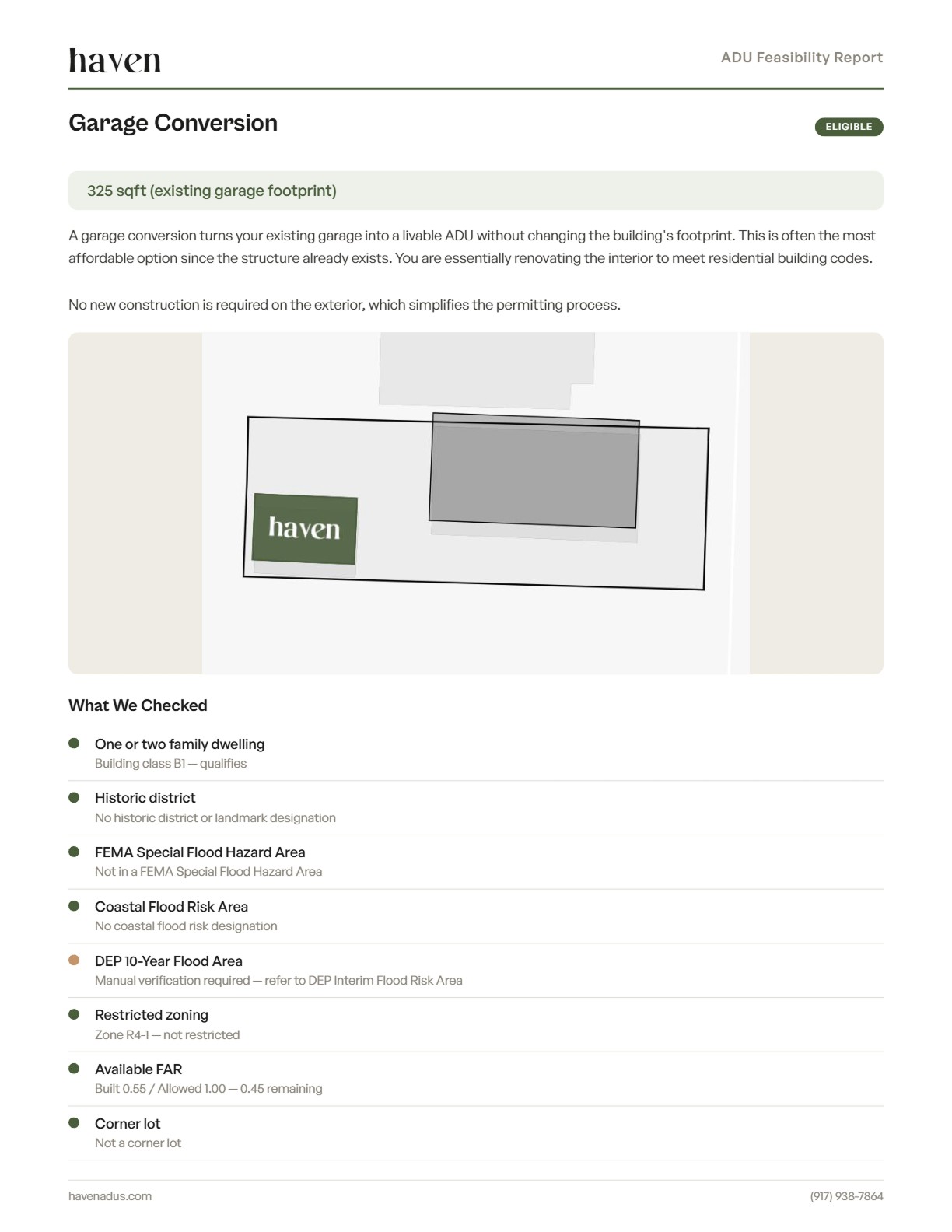
The checks are simpler for a conversion because you’re not expanding the footprint or adding new floor area. The tool verifies the same threshold checks (building classification, flood zones, DOB violations), plus:
Garage detected: Confirms the presence and size of the existing garage, with a confidence rating.
5-foot side access: Confirms rear yard access exists on at least one side.
A few key differences from other ADU types: garage conversions don’t require available FAR (since you’re not adding floor area), are allowed on corner lots, and receive a warning rather than a hard fail in historic districts. No open area calculation, no rebuild envelope, no rear yard coverage check, because the footprint isn’t changing.
Option 3: Attached ADU
An attached ADU is an addition that connects directly to your existing home: a side extension, rear bump-out, or similar addition that shares a wall with the primary house. This can reduce construction costs compared to a standalone structure because you’re building off existing foundation and structural walls.
The trade-off is size. Attached ADUs are constrained by setback requirements on all sides, and NYC mandates minimum habitable dimensions (at least 10 feet wide and 8 feet deep). For our Bronx property, the tool calculated a maximum of 269 sqft.
What the tool checks
Threshold checks: Same as above (building classification, flood zones, DOB violations).
Attachment wall feasibility: The tool measures the gap between the primary building and the parcel boundary on all sides (left, right, rear). At least one exterior wall must have 5+ feet of clearance to allow an attachment. For this property: the rear side has 41 ft of clearance, so attachment is possible.
Setback constraint: R4-1 setbacks (front: 10 ft, side: 5 ft, rear: 30 ft) limit the rear attachment to 269 sqft. Extensions must be at least 10 feet wide (for side extensions) or 8 feet deep (for rear extensions) to be considered habitable.
Maximum attached ADU area: Attached ADUs are capped at 40% of the primary building’s total floor area or 800 sqft, whichever is less. For this property: 40% of 2,070 sqft = 828 sqft, capped at 800 sqft, so the setback constraint (269 sqft) is the binding limit, not the area cap.
Secondary structure clearance: If garages or sheds exist in the expansion path, the attachment is limited to maintain 10 feet of clearance from those structures.
Available FAR: Attached ADUs add new floor area, so the tool confirms there’s enough remaining FAR. Built 0.55 / Allowed 1.00, sufficient.

Option 4: Detached Backyard ADU
A detached ADU is a standalone building in your backyard, separate from your main home. This is typically the highest-value option because it provides the most privacy and flexibility. Under City of Yes, most residential properties can add a detached ADU up to 800 sqft.
But not every property can accommodate one. For our Bronx example, the tool found no valid placement in the buildable zone. The lot is too narrow and the existing structures leave insufficient room for a standalone unit that meets all setback requirements.
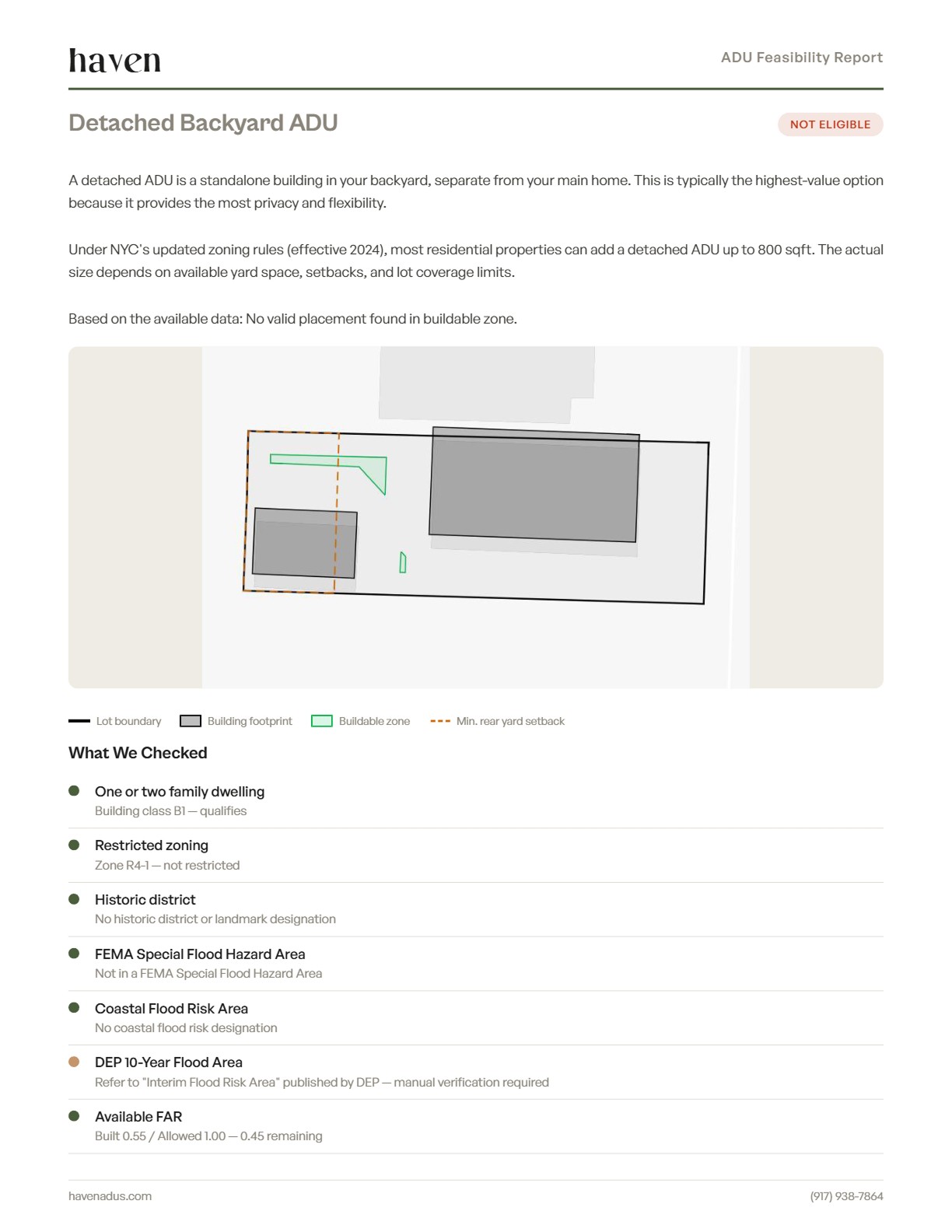
The detached option has the most checks because it’s the most complex to site:
Threshold checks: Building classification, FEMA flood zone, coastal flood risk, DEP flood area, and DOB violations.
Restricted zoning: R1 and R2 zones only permit detached ADUs if the property is in the Greater Transit Zone. Other residential zones are generally eligible.
Historic district: Properties in a historic district or with an individual landmark designation are not eligible for detached ADUs. (This is a hard fail for detached, unlike garage options where it’s a warning.)
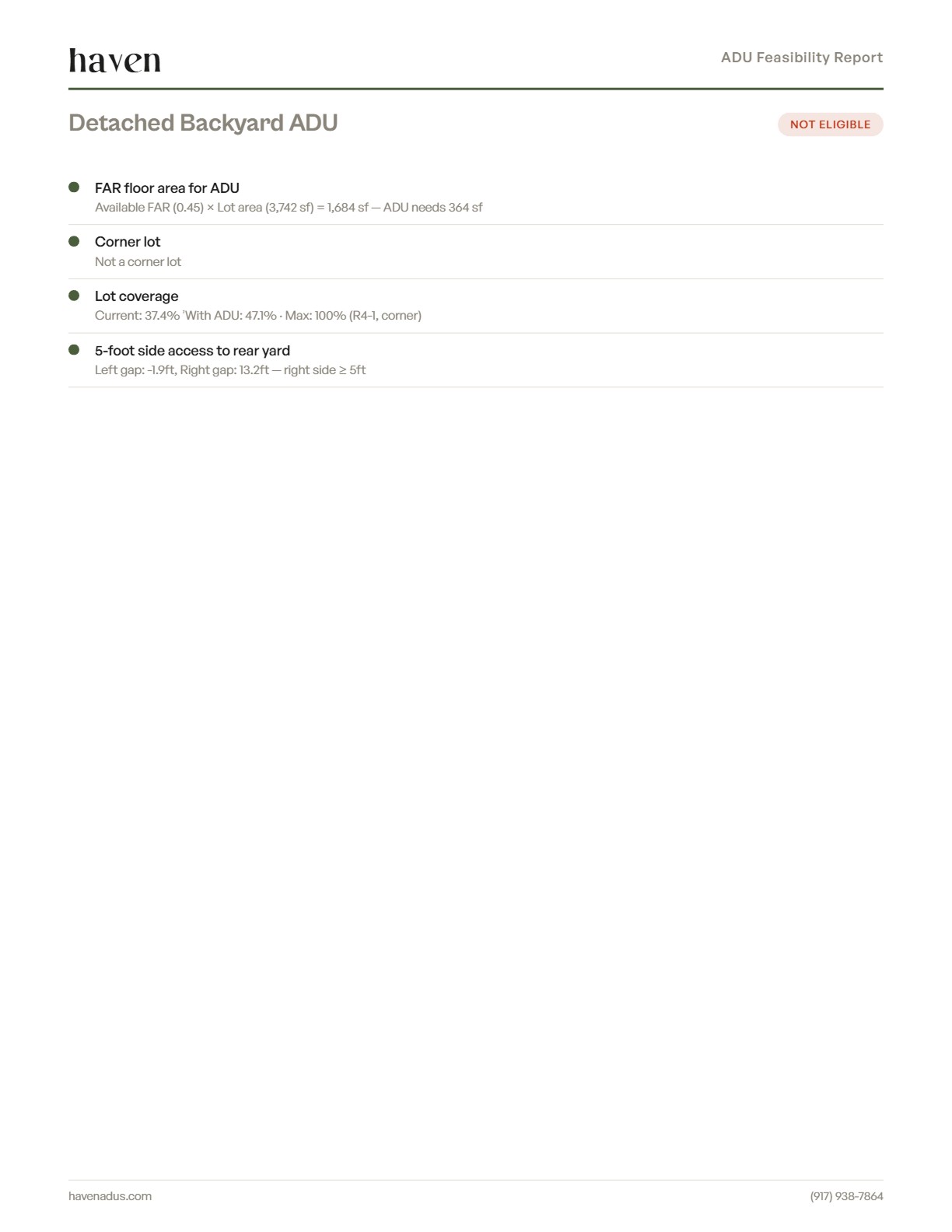
Available FAR: Available FAR (0.45) × Lot area (3,742 sf) = 1,684 sf. The ADU needs at least 364 sf, so FAR passes.
Corner lot: Detached backyard ADUs are not permitted on corner lots under current City of Yes rules. This property is not a corner lot, so it passes.
Lot coverage: Current: 37.4%. With ADU: 47.1%. Max: 100% (R4-1). Passes, but it’s moot because placement fails.
5-foot side access: At least one side must have a clear 5-foot-wide path from the street to the rear yard.
Buildable zone and placement: After computing all required setbacks (5 feet from side and rear lot lines, 10 feet from the main house), the tool tests candidate positions within the remaining buildable zone. It also checks for swimming pool avoidance and the 1/3 rear yard rule.
Despite passing FAR and lot coverage, the physical geometry doesn’t work. This is exactly why the tool evaluates multiple options. This homeowner’s best path is a garage demo and rebuild, not a detached unit.
Every option in your report includes a color-coded overhead map of your property. Here’s what the colors mean:
Solid dark outline: Your lot boundary.
Shaded rectangle: Your existing building footprint.
Green shaded area: The buildable zone, where an ADU could physically go.
Dashed red line: Minimum rear yard setback.
Each ADU type has its own site plan because the buildable zone is calculated differently. A garage rebuild uses open area and rear yard coverage rules; an attached ADU uses setback constraints from the primary structure; a detached unit uses the standard 5-foot side/rear setbacks and 10-foot separation from the main house.
These plans are preliminary layouts based on publicly available data, not final designs. Your actual ADU may differ based on an on-site survey and your design preferences.
Is the feasibility report free?
Yes. Enter your address at havenadus.com/eligibility and you’ll receive your full report, including all ADU options, eligibility checks, maximum sizes, and site plans, at no cost.
How accurate is the report?
The report pulls data from six public databases in real time, including NYC PLUTO, building footprints, parcel boundaries, DOB violations, OpenStreetMap, and Mapbox geocoding. It’s a preliminary feasibility assessment, not a guarantee of permit approval. Final eligibility requires a site survey and DOB review.
What about basement or attic conversions?
The tool currently evaluates four structural ADU types: garage conversion, garage demo and rebuild, attached addition, and detached backyard unit. Haven focuses on these structural projects and does not evaluate basement or attic conversions at this time.
What if my property isn’t eligible for a detached ADU?
That’s exactly why the tool evaluates four options. Many properties that can’t support a detached unit can accommodate a garage conversion, garage rebuild, or attached addition. Our Bronx example is a perfect case: not eligible for detached, but recommended for a 479 sqft garage demo and rebuild.
Why does the tool show different checks for different options?
Each ADU type has different zoning and physical requirements. A garage conversion doesn’t need open area calculations or FAR checks because the footprint and floor area aren’t changing. An attached ADU needs wall feasibility and setback analysis. A detached unit needs the full geometry suite, including buildable zone computation and placement search. The tool runs only the checks that apply to each option.
What does "low confidence" mean for garage detection?
Haven analyzes building footprint data using height, size, and position on the lot to identify garages. "Low confidence" means we detected what appears to be a garage, but the match isn’t definitive. An on-site visit should confirm its exact size and condition. This doesn’t block your eligibility. It’s a flag for the next step.
What data sources does the tool use?
Haven pulls from NYC PLUTO (zoning, building class, FAR, lot area, flood zone flags), NYC Building Footprints (GIS polygons of every structure, including height data), NYC MapPLUTO Parcel Boundaries (lot polygons for setback calculations), NYC DOB Violations (open violation records), OpenStreetMap (swimming pool detection), and Mapbox (address lookup and street detection).
Can I build more than one ADU type?
No. Under City of Yes, each property is limited to one ADU. The report shows all your options so you can choose the best one for your situation.
What happens after I get my report?
Schedule a free consultation at havenadus.com/getstarted or call (917) 938-7864. We’ll review your report together, answer questions, and discuss next steps if you’d like to move forward.