NYC ADU Eligibility Tool.
Enter your address to instantly check if your NYC property qualifies for an Accessory Dwelling Unit under the City of Yes zoning rules. Free, no signup, full feasibility report including site diagrams and downloadable PDF.
How NYC ADU eligibility is determined.
Haven’s tool is a working implementation of the City of Yes for Housing Opportunity zoning rules adopted by NYC in December 2024 (the legal basis for ADUs is Local Laws 126 and 127 of 2024). When you enter an address, we run the same checks the Department of Buildings looks at when approving an ADU permit.
Address to BBL
Your address is geocoded and matched to the city's Borough-Block-Lot identifier. Every check downstream is anchored to that BBL, the same ID DOB and DCP use.
Zoning district lookup
We pull your zoning district from PLUTO (Department of City Planning's Primary Land Use Tax Output). City of Yes allows ADUs in most NYC residential districts, but R1 and R2 zones only permit detached backyard ADUs when the property is in the Greater Transit Zone. Historic districts and individually landmarked properties are not eligible for detached units; garage-based options are flagged for review rather than excluded outright.
Lot geometry and setbacks
We measure your lot from the city's parcel polygon and your existing house from the building footprint dataset. The City of Yes detached-ADU rule (§23-341) requires 5 ft from each side and rear lot line, 10 ft of separation from the existing house, and a one-third rule on the required rear yard. We compute exactly how much buildable space is left.
Floor Area Ratio (FAR)
Every NYC residential zone has a FAR cap on total floor area. We compute how much FAR you have remaining after your existing house. An ADU is a real building and adds floor area, so this is a hard gate.
Flood, historic, and threshold checks
Building classification (1- or 2-family), FEMA Special Flood Hazard Area, DEP Coastal Flood Risk Area, DEP 10-Year Flood Area, DOB open violations, lot coverage, corner-lot flag, 5-foot side access path to the rear yard, and pool avoidance. Each runs as a threshold gate. Flood designations don't always disqualify the lot but typically rule out basement and backyard ADUs; historic-district overlays restrict detached units.
Four ADU options, ranked
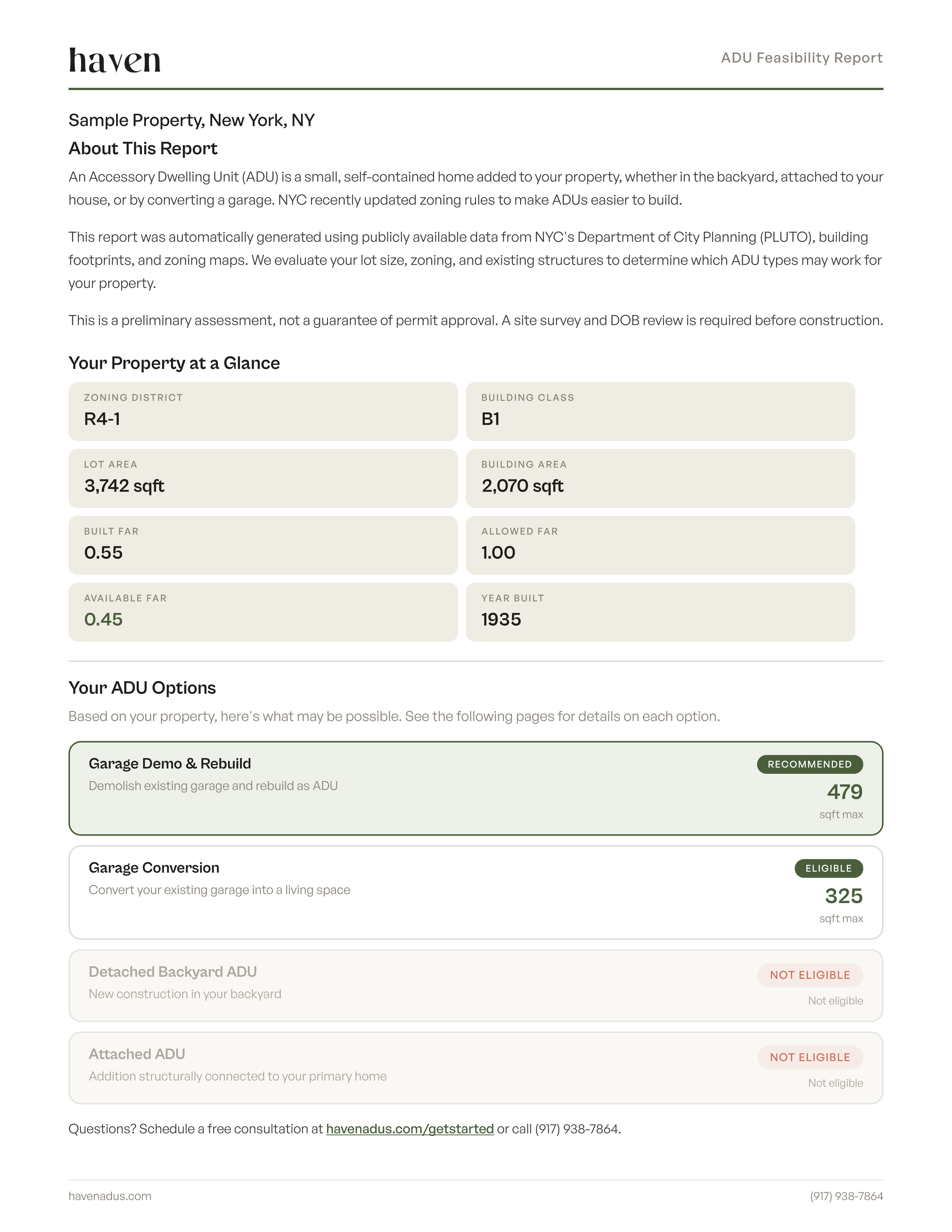
The tool evaluates a detached backyard ADU, an attached extension, a garage conversion, and a garage demo-and-rebuild. Each is checked independently with its own setback, area, and minimum-habitable-dimension rules. You get a maximum square footage, a site diagram, and a recommendation for which option fits your lot best. The tool focuses on structural ADUs and does not currently evaluate basement or attic conversions.
The result is a printable feasibility report you can share with your architect, a contractor, or a family member. It is not a permit; final approval requires a site survey and a DOB filing, both of which Haven handles end-to-end as part of a full ADU project.
We check four ADU types for your property.
Our tool analyzes your lot against NYC’s zoning rules and generates a feasibility report covering four ADU types, each with maximum size, a site diagram, and a detailed eligibility breakdown you can download as a PDF.
Garage conversion
Convert your existing garage into a self-contained living space without changing the building footprint.
Garage demo & rebuild
Demolish an existing garage and rebuild a larger ADU in its place, expanding beyond the original footprint.
Attached ADU
An addition connected to your primary home, like a side extension or rear bump-out that shares a wall.
Detached backyard ADU
A standalone structure in your backyard, separate from your main home. The highest-value option.
Your personalized feasibility report.
Each report includes your property data at a glance (zoning district, lot area, FAR, building class) plus a detailed breakdown of each ADU option with maximum square footage, site diagrams, and the specific checks we ran. Download it as a PDF and bring it to your free consultation with Haven.
- Property data: zoning, lot area, FAR, building class
- Four ADU types evaluated
- Maximum size calculated for each option
- Site diagrams showing buildable area
- Downloadable PDF you can share
ADU eligibility, answered.
Common questions about using Haven’s eligibility tool and understanding your ADU feasibility report.
What is an ADU?
An Accessory Dwelling Unit is a small, self-contained home added to your property, whether in the backyard, attached to your house, or by converting a garage. NYC recently updated zoning rules to make ADUs easier to build.
What does the eligibility tool check?
We analyze your zoning district, lot area, building footprint, FAR, flood zone status, historic district designation, and more, all using publicly available data from NYC's Department of City Planning.
What ADU types does the report cover?
Up to four: garage conversion, garage demo & rebuild, attached ADU, and detached backyard ADU. Each is evaluated independently based on your property's specific constraints, with maximum square footage and site diagrams.
Is the eligibility check free?
Yes. Enter your address and get your full feasibility report at no cost, with no signup required. You can download the report as a PDF to share with family, an architect, or a contractor.
How accurate is the report?
The report is a preliminary feasibility assessment based on PLUTO data, building footprints, and zoning maps. It is not a guarantee of permit approval. A site survey and DOB review is required before construction.
What if none of the options are eligible?
The tool checks against publicly available data, which may not reflect recent changes. If your result is unclear, schedule a free consultation. Our team does manual zoning reviews and can identify options the automated check might miss.